

Designing for Limited Attention During Tax Amnesty Times
Organization : Inter-American Development Bank
Project Overview
Project Summary
An experiment redesigned communication notices sent to taxpayers to evaluate whether salient and clear financial information increases taxpayers’ participation in a tax amnesty program.
Impact
Behaviorally informed notices about the occurrence of tax amnesty had a significant effect on the probability of long-term delinquent taxpayers participating (from 3.33% to 4.33%) and increased the amounts paid by 8%. However, tax amnesty had negative spillover effects in the overall population.
Challenge
Tax amnesties, a limited-time opportunity for a specified group of taxpayers to pay a defined amount of tax liabilities, are broadly used across countries because they generate short-term revenue gains. However, evidence suggest that tax amnesties fail to have long-term effects, and in some cases, they generate negative effects on compliance. With the goal of evaluating the impact of tax amnesties, this experiment relies on the behavioral principle of limited attention and redesigns the communication notice sent to taxpayers by the city of Santa Fe, Argentina in order to reduce cognitive effort and increase understanding of the benefits of participating in tax amnesties.
Design
Two field experiments were run during a tax amnesty period in May 2017 in the city of Santa Fe (Argentina) with more than 54,000 taxpayers who had failed to comply with the payment of their property tax bill (they received the bill but they did not make a payment). The first experiment included taxpayers who owed bills from January 2011 to December 2012 (about 16,000 taxpayers). The second experiment included taxpayers who accumulated debts between January 2013 and March 2017 (about 37,000 taxpayers). The difference in duration of the debt is relevant since debts prescribe after 5 years if the government doesn’t initiate the judicial process, so authorities are likely to direct resources to older debtors and take judicial enforcement steps absent any action by debtors.
In both experiments, standard notices mailed by the government to inform about the tax amnesty opportunity were redesigned to show important information in a more prominent way and reduce information processing or cognitive costs for delinquent taxpayers. Color and other visual techniques were used, as well as an explanation of the different payment plans, including a detailed computation of the reduction in interests that each payment plan provides. The redesigned letter in the first experiment also increased the saliency of a deterrence message that appeared in the original notice to this population. The second experiment included two slightly different versions of the redesigned letter, the only difference being that version B added a column with the computation of interest saved in monetary terms under each plan as opposed to showing just a percentage calculation. Control groups in both experiments received the original notices without redesign.
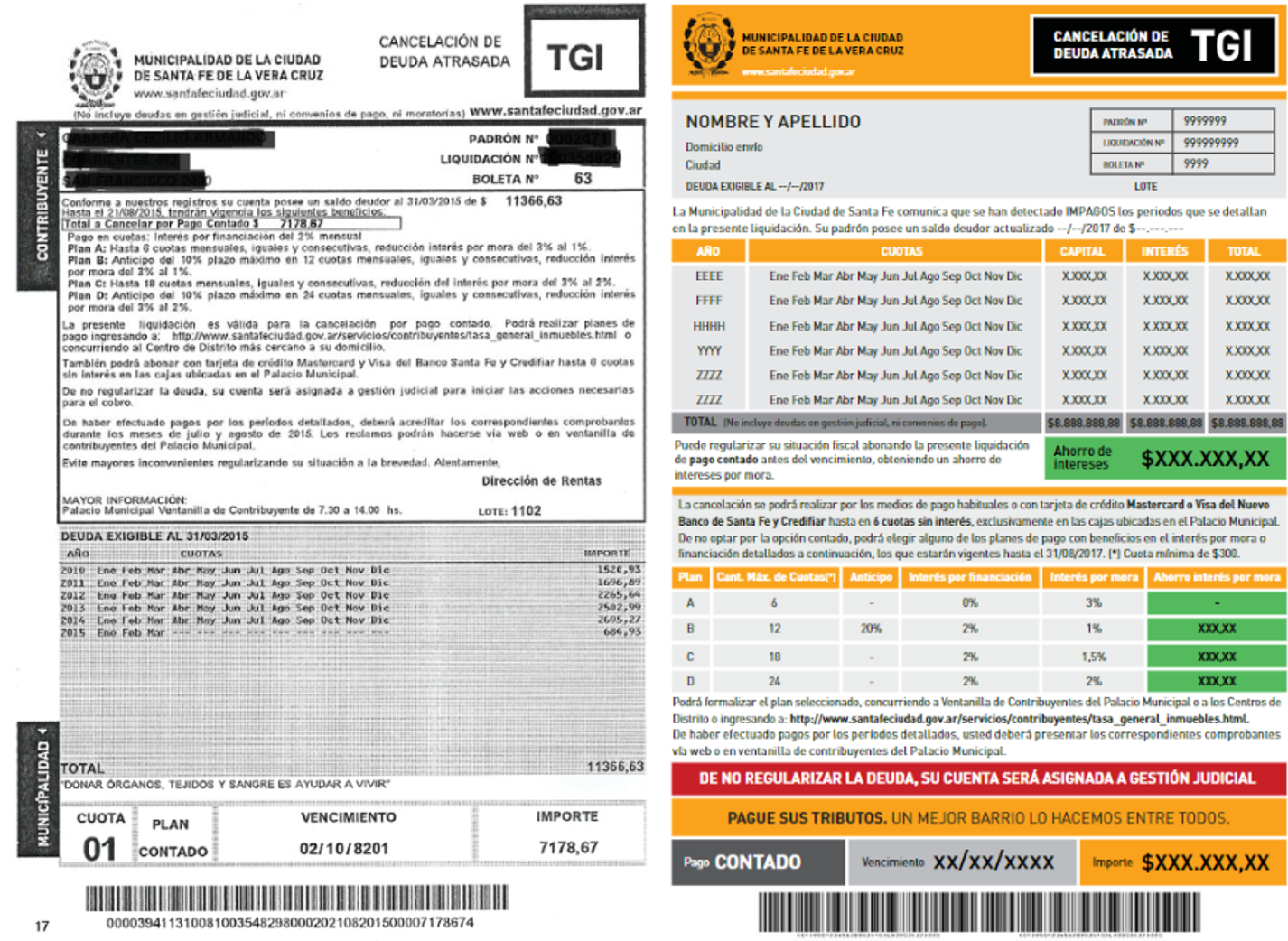
Original notice and redesigned letter, experiment 1
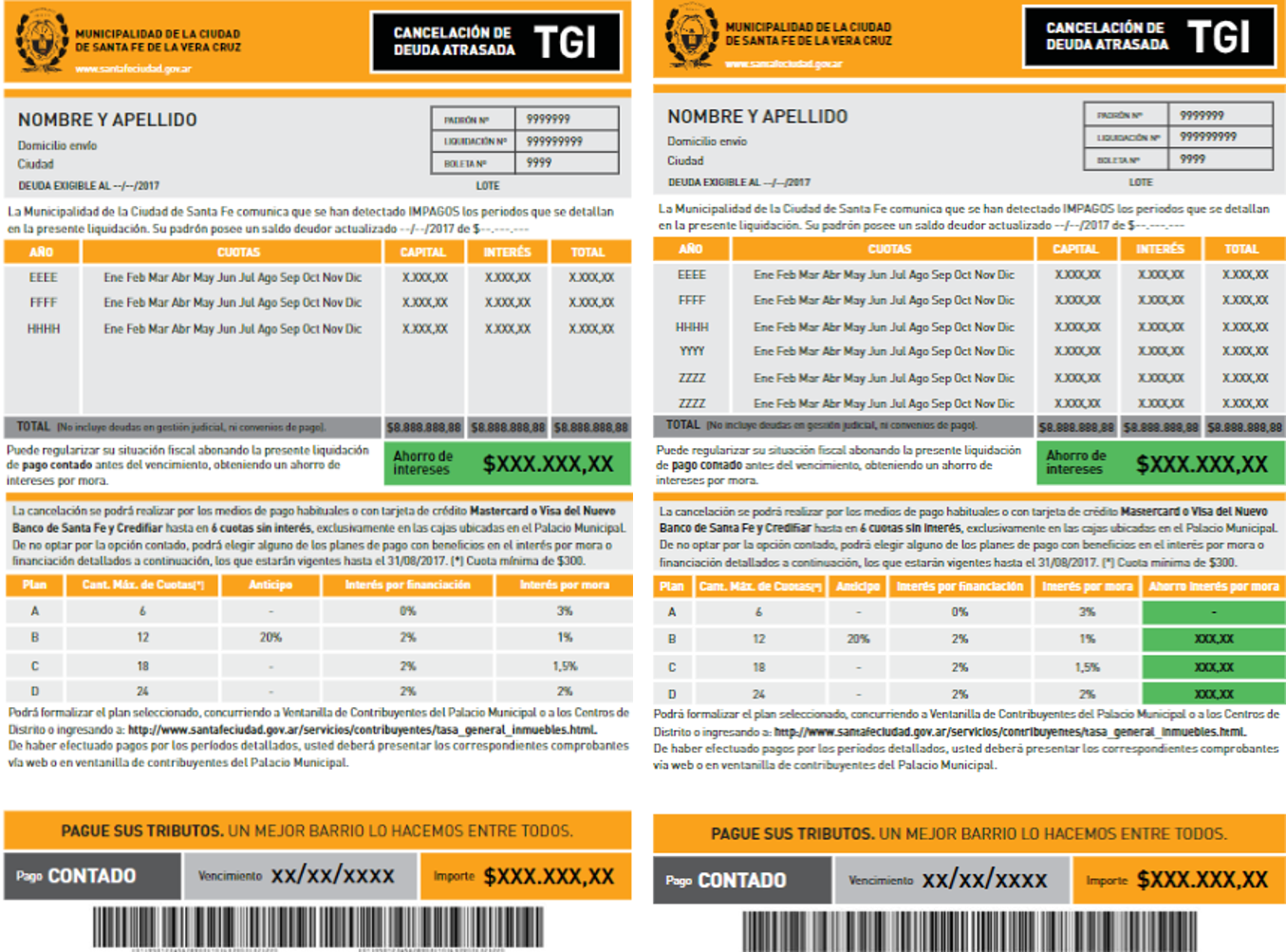
Redesigned letters A (left) and B (right), experiment 2
Impact
Overall results suggest that the way in which government communicates about the tax amnesty has a significant effect. The behaviorally informed notice was found to significantly encourage taxpayers to join the amnesty program. Among debtors reaching the 5-year debt limit (first experiment), the redesign encouraged a 30% higher participation rate than the original notice. Among debtors with more recent debts (second experiment), receiving either version of the redesign letter led to a 7% higher rate of participation in the program than the original letter.
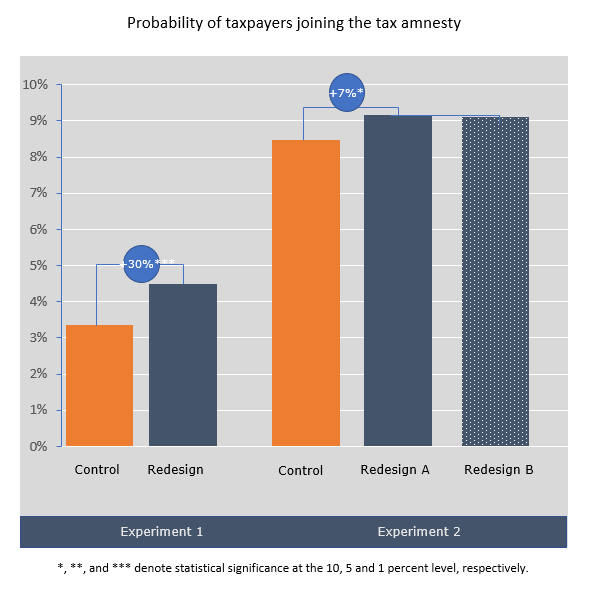
Further, the evidence indicates that taxpayers who received the redesigned tax amnesty notices also paid a significantly higher amount than those who received the old form. The amount collected was 8% higher compared to the control group in the first experiment, and approximately 6% higher during the second experiment; substantial increments in collected taxes.
The stronger results for the redesigned letter in the first experiment compared to the second are consistent with the tax literature showing that the threat of judicial actions can effectively increase tax compliance.
However, despite positive results in terms of repaying current debt and participation rates among delinquent taxpayers, tax amnesties were found to have a negative spillover-effect. Analyzing the behavior of neighbors of those who received the intervention letters, the study found that having more detailed information about the existence of an amnesty program and its benefits may actually encourage non-payment behavior among previously compliant taxpayers in the area.
Implementation Guidelines
Inspired to implement this design in your own work? Here are some things to think about before you get started:
- Are the behavioral drivers to the problem you are trying to solve similar to the ones described in the challenge section of this project?
- Is it feasible to adapt the design to address your problem?
- Could there be structural barriers at play that might keep the design from having the desired effect?
- Finally, we encourage you to make sure you monitor, test and take steps to iterate on designs often when either adapting them to a new context or scaling up to make sure they’re effective.
Additionally, consider the following insights from the design’s researchers:
- This study found no difference in effect by adding the amount of interest saved during each plan in experiment 2. The fact that the savings tend to be low might have biased the decision of taxpayers. However, for administrative reasons the amount in financial interest each taxpayer would have to pay could not be computed because it depends on the number of installments each taxpayer chooses under each plan. Including that computation might have been a more valuable piece of information to taxpayers.
- It is also important to note that each notice includes a payment stub to make the single installment payment. Therefore, while those who decide to pay the single installment can go straight to a bank and make the deposit, those who want to pay off their debt using a payment plan have to register online to get the corresponding payment stub or visit the city government offices. Despite the notice including a clearly explained procedure to follow, the transaction costs are much higher for those would prefer a payment plan, which could hinder their adoption.
- Credit constraints may play a big role in the decision to make payments. In this experiment, the minimum payment established for each payment plan was several times higher than the monthly tax bill. As such, many people could not afford making use of the amnesty.
- The negative spillover effect of tax amnesties can generate negative incentives for tax compliance in the overall population. Thus, tax amnesties can only be used sparingly, in the context of fundamental reforms that provide a rationale for opening an amnesty, and only if the threat of increased enforcement is real.
Project Credits

Researchers:
Edgar Castro Inter-American Development Bank
Carlos Scartascini Inter-American Development Bank