

Rewarding Weight Loss in Teams is Better
Organization : Center for Health Incentives and Behavioral Economics
Project Overview
Project Summary
Overweight employees at the Children’s Hospital of Philadelphia were placed into groups of five. A $500 reward was then shared each month among members of each group who met their weight-loss goal.
Impact
Incentivizing employees in groups helped them lose an average of 2.9 kg (6.39 lbs) more than employees who were not offered incentives, while offering individual incentives did not have a significant impact.
Challenge
As of 2010, more than 2 in 3 adults in the United States are overweight or obese, and many employers use financial incentives to help their employees stay healthy. Research from the behavioral sciences helps identify the types of rewards that achieve the greatest impact.
Design
Overweight employees at the Children’s Hospital of Philadelphia were asked to identify a monthly weight loss goal. They then received information about weight management, attended monthly weigh-ins, and received messages about whether they had met their monthly goals. A sample of these employees were additionally assigned to one of two incentive programs:
- In the individual-incentive program, employees received $100 every month they met their weight-loss goal.
- In the group-incentive program, employees were sorted into groups of 5 (without knowing the identity of the other members). Each month, they received $500 to be shared equally among group members who reached their monthly goal.
An automated message sent at the end of the month notified employees in both incentive programs about how much money they had earned, or could have earned if they had met their weight-loss goal.
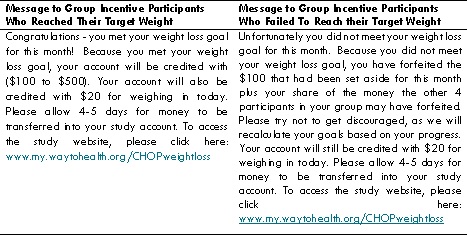
Participants only received their share of the group incentive if they met their monthly weight-loss goal

Impact
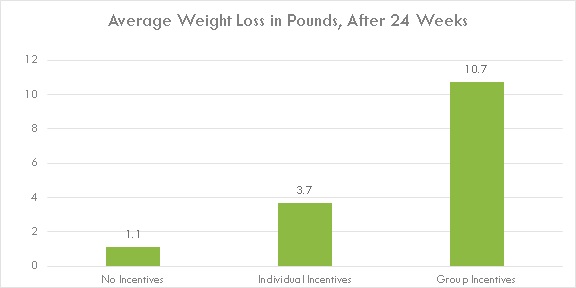
A randomized evaluation found that twelve weeks after the incentives ended, employees in the group-incentive program sustained greater weight-loss, losing an average of 2.9 kg (6.39 lbs) more than those not offered any incentive. In contrast, employees in the individual-incentive program did not lose significantly more weight than employees who were not offered any incentives at all.
Implementation Guidelines
Inspired to implement this design in your own work? Here are some things to think about before you get started:
- Are the behavioral drivers to the problem you are trying to solve similar to the ones described in the challenge section of this project?
- Is it feasible to adapt the design to address your problem?
- Could there be structural barriers at play that might keep the design from having the desired effect?
- Finally, we encourage you to make sure you monitor, test and take steps to iterate on designs often when either adapting them to a new context or scaling up to make sure they’re effective.
Additionally, consider the following insights from the design’s researcher:
- Providing more frequent rewards may increase the effectiveness of individual-based incentives.
- Splitting the reward only between group members who meet a goal can stimulate competition and drive.
- Notifying individuals about the money they could have earned had they met their weight-loss goals can activate a feeling of regret and enhance engagement with the weight-loss program.
Project Credits
Researchers:
Jeffrey T. Kullgren Contact University of Michigan
Andrea B. Troxel Perelman School of Medicine at the University of Pennsylvania
George Lowenstein Carnegie Mellon University
David A. Asch University of Pennsylvania
Laurie A. Norton Perelman School of Medicine at the University of Pennsylvania
Lisa Websy Perelman School of Medicine at the University of Pennsylvania
Yuanyuan Tao Perelman School of Medicine at the University of Pennsylvania
Jingsan Zhu Perelman School of Medicine at the University of Pennsylvania
Kevin Volpp University of Pennsylvania